

In the Kashmir Valley of India, they have a saying, “We know only two words that are meaningful – one is Allah, the other is Lalla.”
Lalla is the land’s most illustrious female mystic-poet, acclaimed equally by Hindus and Muslims. Her life and sayings have been largely responsible for shaping the character and mindset of people for the past seven hundred years. She is the creator of vatsun or vakh (literally, “speech”) style of poetry that showcases her mysticism, insights into human existence, and literary genius. In Kashmir’s history, her contribution to its spiritual, cultural, and academic heritage remains unparalleled, making her a strong pillar of its identity.
Known as Lalleshwari, Lal Ded (literally, Mother Lalla), Lalla Yogeshwari, Lalla Arifa, or simply Lalla (1320–1392 CE), her life story is shrouded in myths and legends. Early biographies state she was born in Panderthan village near Srinagar, in Kashmir valley. The year was likely 1320 during the reign of Sultan Alau-ud-din. Her father was a Kashmiri Pandit or Brahmin named Cheta Bhat. In her early years, Lalla received a brief education in religious texts. According to reports, she had clear memories of her previous births.
A Life of Hardship and Spiritual Awakening
She was married at the age of twelve into a family that lived in Padampur or Pampore. Her in-laws gave her the name Padmavati, but she was never identified by that name. Unfortunately, her marriage proved to be deeply unhappy. The mother-in-law detested the new bride and treated her with sadistic cruelty. She would put a stone on her plate and cover it with a thin layer of rice to make it appear as a large serving. But the noble-minded Lalleshwari never complained. She even washed the stone after eating so that it would be clean for use in the next meal. To this day, there is a saying in Kashmir, “Whether they killed a goat, Lalla always had a stone for her dinner.”
Every morning, Lalla would go to the nearby river to fetch water for household use. She then secretly crossed over to the Shiva temple yonder. That was her refuge. The quiet atmosphere and peaceful vibrations lulled her into a trance. She worshipped the deity and became absorbed in meditation for hours. Gradually, her spiritual power began to manifest, and her reputation grew as a result of the miracles she performed. People from far-flung places came to have darshan of the saintly girl. If they asked for succor, they got it. If they wanted advice, she gave it. If someone was ill, she cured them. Whatever she uttered came true.
The mother-in-law was green with envy at all the respect and adulation young Lalla was receiving. She poisoned her son against her: “Lalla says she goes to fetch water but does not come back for hours; she must be having an affair.” The following day, when Lalla came home with the water pot on her head, her husband was waiting for her. Seething with anger, he grabbed a rod and smashed the earthen pitcher to smithereens. But a miracle occurred! The water did not spill over when the jug broke; it remained intact like a solid mass until Lalla poured it into another vessel! The rest she threw out of the house, where a lake came up, or so the story goes.
She had had enough; she walked out of her marital home and never looked back. She was only twenty-four at the time. The young rebel set forth on a path few women before had taken – the journey to Self-realization. Her spirit was dauntless. She roamed the hills and the forests, the glens and the valleys of the magnificent land of Kashmir in search of a master. She trained under many teachers, performed severe austerities, and did intense meditation. Finally, she met her guru Siddha Srikantha (Sed Bayu). He initiated her into the mystical tradition of Kashmiri Shaivism. Initiation from a competent guru is a prerequisite of this lineage.
Kashmiri Shaivism was known as Trika Shaivism before 1900 CE. It is a non-dual, oral tradition that identifies Shiva as the Absolute Reality (Paramshiva), the Reality behind all phenomena. It advocates a path of devotion to and worship of God as formless (Nirguna Brahman). It rejects rites, rituals, and sacrifices while emphasizing self-introspection.
According to Swami Lakshmanjoo, doyen of Kashmiri Shaivism, the word “Trika” means the threefold science of man and his world. It signifies Shiva, his dynamic energy (Shakti), and the individual (jiva). For the seeker, liberation can be attained through intense meditation on Shiva as the Supreme Reality and recognition of the Supreme Reality’s identity with the individual soul. Lakshmanjoo states, “God and the individual are one. To realize this is the essence of Kashmir Shaivism.”

A curious blend of intense Shiva bhakti and Sufi mysticism, Lalleshwari’s sayings reveal her limitless devotion, spiritual illumination, wisdom, and ecstasy of divine union.
The Rise of a Yogini and the Power of Her Vakhs
Following the instructions of her master, Lalla soared to new mystical heights. She is said to have surpassed even her mentor in spiritual attainments. She became widely known as a yogini with supernatural powers, attracting massive crowds wherever she went. She had transcended body consciousness and become an avadhuta. Wandering naked from one place to another, she spoke directly to the masses through her vakhs. People began to address her reverentially as Lal Ded or Lalleshwari. Often describing her experiences using Shaivite symbolism, she sang:
I, Lalla, entered
the gate of the mind’s garden and saw
Siva united with Sakti.
I was immersed in the lake of undying bliss.
Here, in this lifetime,
I’ve been unchained from the wheel
of birth and death.
What can the world do to me?
And
My guru gave a single precept:
turn your gaze from outside to inside
fix it on the hidden self.
I, Lalla, took this to heart
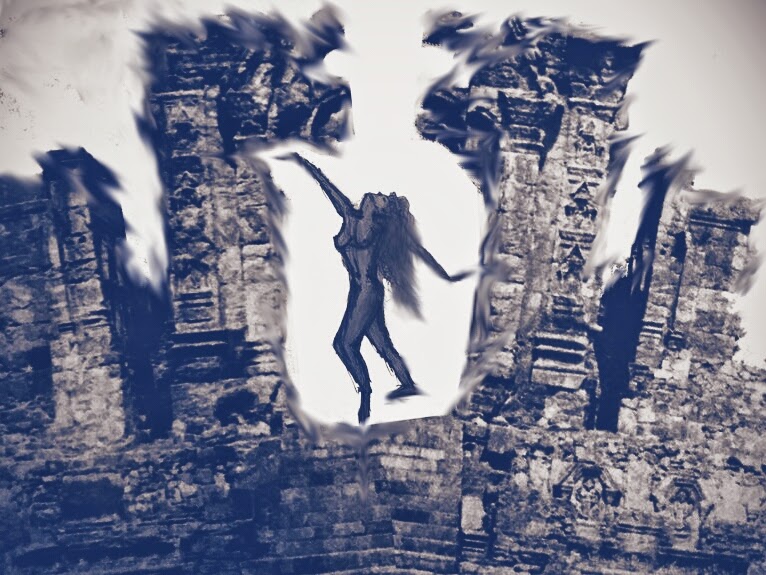
and naked set forth to dance.
Once, she encountered a gang of rowdies who were making fun of her nudity. A silk merchant came to her defense, who chastised the youths and drove them away. From him, Lalla took two bolts of silk of equal weight. She put one on each shoulder and was on her way. Throughout the day, she tied a knot in the cloth on her left shoulder whenever someone ridiculed her. Similarly, each time someone praised her, she secured a knot in the fabric on the right. At day’s end, she returned to the vendor and asked him to weigh the bundles again. They weighed exactly the same as before. She then pointed out that the bundles remained equal in weight, whether blame or praise came her way. And so must the mind remain balanced under all circumstances. Thus, in her unique way, she demonstrated that mental equipoise must not be shaken by how people treat you.
In Lal Ded’s time, Kashmir was in the throes of transition and chaos. It witnessed the gradual decline of Hindu political and religious power. With the advent of Muslim rule and the subsequent mass conversions, Islam became the dominant religion. Simultaneously, Sufism made its way into the region as missionaries from Central Asia and Persia flocked to the valley. They encouraged the Muslim rulers to ban idol worship and enforce orthodox Islam. The Hindu population, meanwhile, remained largely Shaivite. Kashmiri Shaivism went underground for many centuries. Although there may have been practitioners, there is no documented evidence of it after the 14th century. The grand tradition was revived only in the 20th century by Swami Lakshmanjoo.
One of the outcomes of the extensive activity of Sufis was the emergence of the Rishi movement, a Sufi tradition. According to Riyaz Punjabi, Vice-Chancellor of the University of Kashmir, “The intermingling of Trika Shaivism with Islam resulted in the emergence of Rishi cult, a synonym for Bhakti. It was through the Rishis that Islam in its indigenous form became the popular faith of the people.” He also points out that Lal Ded was the torch-bearer of the Rishi cult in Kashmir.
The association of Lalla with Nund Rishi, founder of the Rishi movement, is an interesting story. Honored as the patron saint of Kashmir, Nund Rishi was a Sufi mystic, scholar, and Islamic preacher. He is also known as Sheikh Noor-ud-din Noorani or Sahazanand (The Blissful One) by his Hindu followers. They say that as a newborn, he refused to drink his mother’s milk, and it was Lal Ded who came to suckle the baby. Again, it was Lalla who was a great source of inspiration to him as he grew up. They seemed to have a spiritual connection, and with Lal Ded’s encouragement, he established the Rishi order. Paying tribute to his spiritual mother, he later wrote:
That Lalla of Padampur.
Who had drunk the fill of divine nectar;
She was undoubtedly an avatar of ours.
Oh, God! Grant me the same spiritual power.

Lalleshwari’s vakhs have been translated into English by modern scholars. Also, a solo play in English, Hindi, and Kashmiri titled ‘Lal Ded’ has been doing the rounds for many years. It is directed and performed by noted actress Meeta Vashisht.
A Bridge Between Two Faiths
According to another legend, one day, when Lal was about seventy years old, she was caroling her vakhs before a large crowd. When she finished, she calmly climbed into a large earthen pot, and once inside, she covered it with another jar. A long time elapsed, but Lalla did not emerge. When the anxious spectators pulled the jugs apart, they found them empty. The yogini had vanished! Devotees believe that she had foreseen a dispute between her Hindu and Muslim followers over her last rites – whether her body should be buried or cremated. So, Mother Lalla chose another way to exit the earthly plane. She disappeared into thin air, so to speak, leaving no room for a fight among her disciples.
However, she was supposedly laid to rest in a tomb in Bijbehara town near the shrine of Baba Naseeb-ud-din Ghazi. Ghazi was a disciple of Hamza Makhdoom. Either way, Lalla would not have cared because:
Alike for me is life and death,
Happy to live, happy to die,
I mourn for none,
None mourn for me.
Hundreds of years after her death, Lalleshwari’s spirit endures through her mystical musings. Today, she is a much-loved literary and spiritual figure in the Kashmir region. Her life and poems are deeply rooted in Kashmiri culture, shaped by both Hinduism and Islam. Her vakhs are the earliest compositions in simple Kashmiri, drawing idioms from day-to-day life. She sang with all the fervor of a true mystic about her journey to Truth and her spiritual experiences. She spread the universal message of love and tolerance. A curious blend of intense Shiva bhakti and Sufi mysticism, her sayings reveal her limitless devotion, spiritual illumination, wisdom, and ecstasy of divine union. They serve as a beacon of inspiration to both the layperson and the intellectual.
Lalla’s poems also reflect the turmoil of her time – a society in flux. They are a vivid testament to the political and social upheavals that impact people’s lives. She wrote without fear, providing a stinging critique of the prevailing hypocritical value system. She was a loud dissenter of casteism and abhorred the cruel injustices of the elitist Brahminical order. She challenged organized religion, rejected ritualism, and decried false religiosity. She took a compassionate look at human existence with its everyday hardships. Every Kashmiri, whether Hindu or Muslim, young or old, has been touched by her poetry; it is deeply entrenched in the Kashmiri psyche.
Some of her famous verses are:
Whatever work I did became worship of the Lord;
Whatever word I uttered became a prayer;
Whatever this body of mine experienced became
the sadhana of Shaiva Tantra
illumining my path to Paramshiva.
Your idol is stone, your temple a stone too
All a stone bound together from top to toe!
What is it you worship, you dense Brahmin?
Bind but the vital air from the heart to the mind.
Shiva is difficult to attain; take a hint for guidance (from thy guru)
I have seen an educated man starve,
a leaf blown off by the bitter wind.
Once, I saw a thoughtless fool
beat his cook.
Lalla has been waiting for the allure of the world to fall away.
What the books taught me, I have put into practice.
What they didn’t teach me, I taught myself.
I have gone into the forest and wrestled with the lion.
I didn’t get this far by teaching one thing and doing another.
(Translated by Andrew Schelling)
Lalleshwari’s Legacy
About two hundred in number, her didactic quatrains showcase her poetic genius. Now they are an intrinsic part of the folk tradition of the region. It is said, “Lalla is to Kashmiris what Shakespeare is to the English.”
Lal Ded’s compositions were mainly passed down in the oral tradition. The vakhs were written down only after her death. Lately, they have gained enormous popularity worldwide, with her poems translated into English by modern scholars. Some well-known books by US-based authors include Jane Hirshfield’s ‘Women in Praise of the Sacred: 43 Centuries of Spiritual Poetry by Women’, Coleman Barks’ ‘Naked Song: Lalla’, and Jaishree Kak’s ‘Mystical Verses of Lalla’.
Other performative arts based on Lalleshwari are contemporary renditions of her poetry in song. Meanwhile, a solo play in English, Hindi, and Kashmiri titled ‘Lal Ded’ has been doing the rounds since 2004. It is directed and performed by noted actress Meeta Vashisht.
Despite being steeped in traditions of the day, Lal Ded was secular and tolerant. As a rebel, she chronicled the social evils of her time and raised people’s awareness. She defined her relationship with God in universal terms, viewing everything as emanating from a single, unified reality. She was the only woman Kashmiri saint in the lineage of Trika Shaivism. Her poems revived the dying tradition. She was also the only woman Kashmiri saint to embrace Shaivism and Sufism. Her Shaivite-Sufi lineage has made her a beloved figure among both Hindus and Muslims. Scholars see her as a historical bridge between the two communities. According to author and poet Ranjit Hoskote: “To the outer world, Lal Ded is arguably Kashmir’s best-known spiritual and literary figure; within Kashmir, she has been venerated both by Hindus and Muslims.”
An extract from ‘India’s Spiritual Heroines’ by Nandini Kapadia is published with permission from the book publisher, Motilal Banarsidass (MLBD.com).
About the book

‘India’s Spiritual Heroines’ by Nandini Kapadai is an anthology of the biographies of 33 female sages, saints, mystics, and ascetics from India’s history, spanning from the Vedic period to the 21st century. She aims to honor and preserve the legacy of these women, whom she considers “spiritual heroines” for their courage and outstanding achievements in overcoming societal disadvantages to follow their calling.

Leave a Reply