


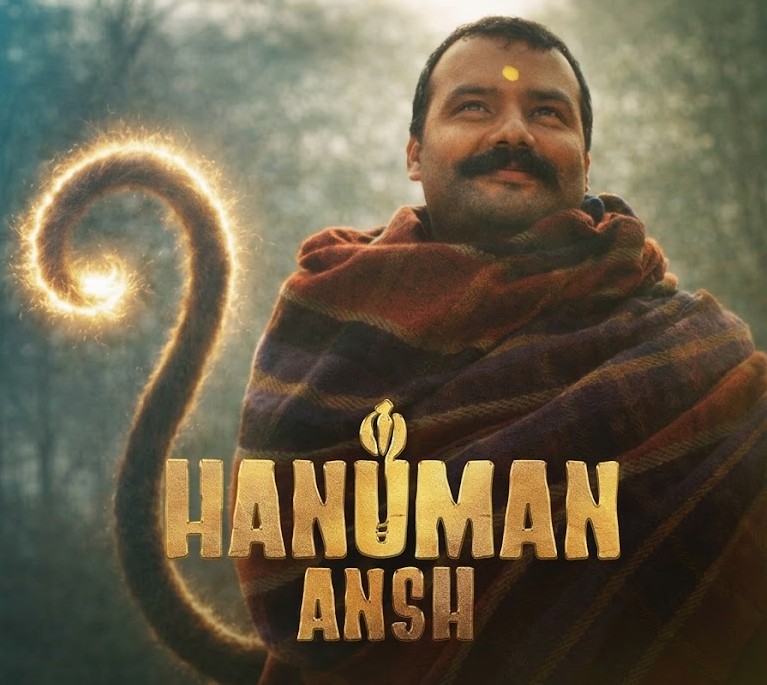
Avoiding the weekend, we chose a Tuesday afternoon and were pleasantly surprised to find the theater almost full. A friend and I went to watch the life of a man who was an ansh (part) of Lord Hanumān and came away wondering how much of our own lives belong to Bhagavān.
Hanumān Ansh, the first part of the cinematic telling of Neeb Karori Bābā’s life (better known as Neem Karoli Baba), opens with Maharaj-ji telling Dr. Bhonsale that Nehru (Jawaharlal Nehru, the first Prime Minister of independent India) has passed away without meeting him. From then on, the story moves back and forth through the various facets of Lakṣmī Nārāyaṇa’s life, the boy from a small Indian town, Akbarpur in Uttar Pradesh, who loses his mother very young and sets out in search of Rām ke ghar (Lord Rama’s house), where he believes her soul rests. What follows is the life of a man for whom Rāma-bhakti became the way of life.

A life surrendered to Lord Rama
An early scene at a maṭha in Gujarat stands out. Young Lakṣmī Nārāyaṇa speaks to birds and trees as naturally as another child might speak to his companions. He does not know that there is anything extraordinary in this. For him, this is simply the way the world is. The Mahant sees what the boy himself cannot see. He recognizes in him something of his own guru. The boy has come as a śiṣya (disciple), yet his presence reminds the Mahant of his own guru. The grace he had once received seems to have returned before him in another form.
From then on, the film becomes difficult to watch from a distance. The simplicity of the people, the villages, their way of living, the mud houses, and the cow-dung chulha (stove) begins to raise an uncomfortable question. How much have we added to our lives that was never required? How many expectations, ambitions, and anxieties have become so familiar that we mistake them for life itself? Watching this young man move through the world with such extraordinary naturalness, one is left longing to shut out some of the noise and turn inward.
There is something almost painful about that simplicity. The film makes one feel how magical life can be when the unnecessary falls away.
Maharaj-ji’s life is centered on Sītā-Rāma, but the film does not make a declaration of this at every turn. It allows us to see it in the way he lives. Even the extraordinary seems to happen around him without becoming a source of self-importance.
Watching the Baba as a young man move through the world with such extraordinary naturalness, one is left longing to shut out some of the noise and turn inward. There is something almost painful about that simplicity. The film makes one feel how magical life can be when the unnecessary falls away.
When faith becomes darsana
There is a particularly beautiful moment in the episode with his param bhakta (arch-devotee) Gopāl. Seeing Maharaj-ji meditating in a cave, Gopāl beholds Mahādeva, with snakes slithering around His body, and is overwhelmed. Maharaj-ji tells him that he saw Lord Śiva because Śiva was already in his heart.
There is so much packed into that one sentence.
What is darśana (divine view) if not the meeting of what is before us with what already lives within us? The old statement yad bhāvaṃ tad bhavati (You become as you think) suddenly feels less like something one reads in a text and more like something one has witnessed. Gopāl does not merely see Maharaj-ji as Śiva. He sees according to the bhāva (state of being) he carries within him.
And Maharaj-ji does something else that is equally beautiful. He does not take the glory of the experience. The miracle returns to Bhagavān.
This happens repeatedly in the film. From the episode of the train that refuses to move after Maharaj-ji and his bhaktas are asked to leave to the jail episode where he is wrongly detained by SHO Nasir Ali, Hanumān-ji’s siddhis (spiritual powers) appear, astonishing things happen, people receive timely help, and Maharaj-ji seems almost uninterested in taking credit.
There is a particularly profound scene with his father that unravels many layers. Meeting his son after fifteen years, his father reminds Maharaj-ji of his childhood marriage, something Maharaj-ji seems to have forgotten. He has already given himself to Prabhu (Almighty) and cannot see why he should return to married life. His father then reminds him of his iṣṭa Prabhu Rāma, the Maryādā Puruṣottama, who did not abandon his responsibilities in the name of renunciation.
The verbal exchange is simple, but the question beneath it is profound. What is svadharma (personal duty and path in life)? When does renunciation become genuine tyāga, and when can it become an escape from what Dharma has placed before us?
Maharaj-ji returns to family life. This episode gives us a glimpse of something our tradition understands so well. Tyāga is not always about physical departure. One can live amidst relationships and duties and still loosen the hold of moha (attachment). One can fulfill one’s duty without making it the center of one’s identity.
And Rambetī gradually comes to understand the man she has married. He cannot be held in the ordinary way. His life has already been offered elsewhere.
Another profound episode is the Hanumān Cālīsā recitation. The teaching is wonderfully direct: what is the fruit of saying the words if the mind is somewhere else? A thousand recitations cannot substitute for turning towards Hanumān with the heart.
For anyone who does japa (meditative repetition of a mantra), this hits differently.
How often do the lips continue while the mind has wandered elsewhere? How often do we count the repetitions and forget the One whose name we are repeating?
The film keeps bringing us back to this question of attention. Maharaj-ji’s life seems to have had very little of the fragmentation that marks ours. His mind knew where it belonged.

What the film leaves behind
The performances, the dialects, and the simple settings add to the feeling that we are watching lives rather than constructs. Shobhinaw Satyaa fits the role of Maharaj-ji naturally. There is an ease in his manner and presence that makes it easy to simply accept him as Maharaj-ji.
The story’s back-and-forth flow and the film’s bhāva may feel uneven at times, but the bhāva of the film carries it through.
The music stays with you too. Sadhu Tiwari’s renditions of “Āvāgaman” and “Jab zid pe aa gayī Pārvatī” sit beautifully within the film.
When the credits rolled, almost the entire audience remained seated until the theater staff began preparing for the next show. We stayed too and realized we weren’t the only ones quietly wiping away tears.
September 11, 2026, marks 53 years since Maharaj-ji left his physical body in Vṛndāvana. Perhaps the best way to remember him is with the words that close the film:
कथा ये विशेष है।
कथा अभी शेष है।
Sītā-Rām. Sītā-Rām.
For another take on the movie ‘Hanuman Ansh’, read:



Leave a Reply