


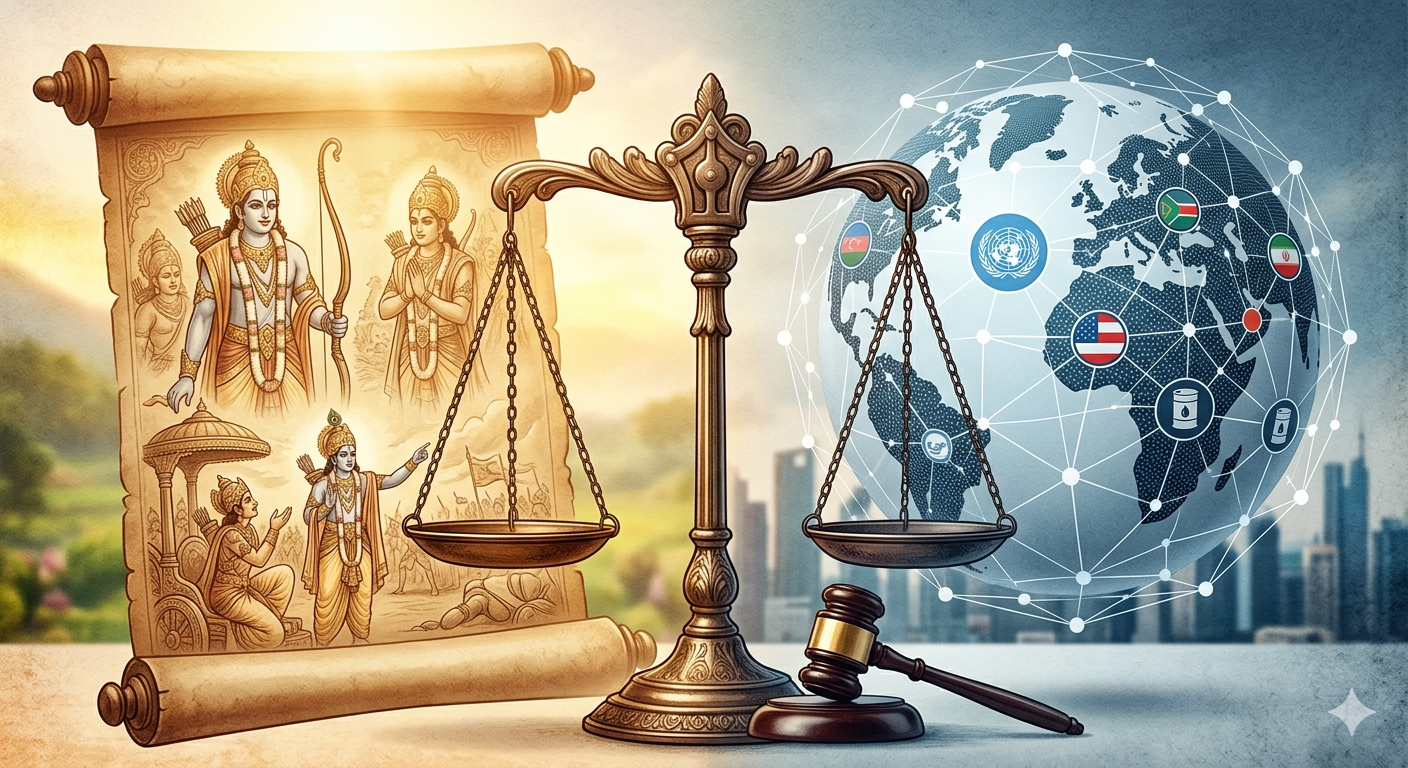
War stands at the absolute center of India’s two great epics, the Ramayan and the Mahabharat. However, their conclusions offer a startling contrast. The Ramayan ends in restoration: the tyrant Ravan is vanquished, Sita is liberated, and Lord Ram establishes Ram Rajya—the ideal, righteous state.
The Mahabharat, conversely, leaves us with a haunting image of “scorched earth.” Its aftermath—a landscape populated largely by widows and orphans—is enough to turn any heart against the concept of armed conflict. Yet, it was within this very setting that Lord Krishna counseled Arjun to fight. His reasoning? The war was “just,” necessary to defeat the evil designs of Duryodhan and restore the moral compass of the world.
The pillars of Dharma Yuddha
In Hindu philosophy, a just war is known as Dharma Yuddha. It is a righteous battle fought to uphold dharma (justice, duty, and cosmic order) against adharma (evil. unrighteousness). Crucially, Dharma Yuddha is a last resort. It is justified only when every avenue of peace has been exhausted, and its goal must be the protection of the innocent rather than selfish gain.
We see this exhaustion of diplomacy in both epics. In the Ramayan, Lord Ram sends multiple envoys to Ravan, pleading for the respectful release of Sita, only to be rebuffed. In the Mahabharat, Krishna himself acts as a mediator, famously proposing that the five Pandav brothers would accept a mere five villages in lieu of their rightful half of the kingdom. The Kauravas’ refusal made war inevitable.
There is a popular folk saying in India that all wars are fought over three things: Zar (money), Zoru (woman/family), and Zamin (land). While the Lanka war was sparked by the abduction of Sita, the Great War of Kurukshetra was a dispute over Zamin. In the modern era, provocation is almost always a mix of territory and Zar—often in the form of oil or resources.
From St. Augustine to the UN
The concept of the “Just War” is also deeply rooted in Western philosophy. Developed by early Christian theologians like St. Augustine in the 4th century and later refined by St. Thomas Aquinas, the theory sought to reconcile the biblical prohibition against killing with the moral duty to defend the vulnerable.
Today, this framework remains the bedrock of international law and statecraft. It dictates two main categories: Jus ad bellum (the right to go to war) and Jus in bello (right conduct within war). For a war to be “just” today, it must meet strict criteria:
- Just Cause: Protecting life or responding to aggression.
- Proper Authority: Sanctioned by a recognized body (like the UN).
- Right Intention: Aiming for a sustainable peace, not revenge.
- Proportionality: The good achieved must outweigh the suffering caused.
The modern dilemma
In our current landscape, these theories are being tested to their breaking point. We see “Just War” invoked for humanitarian interventions to prevent genocide, yet we also see it challenged by the existence of nuclear weapons, which by nature violate the principle of discrimination between combatants and civilians.
Furthermore, the United Nations—intended to be the arbiter of these laws—is increasingly viewed as a “toothless tiger.” Its power is often hamstrung by the vetoes of the five permanent Security Council members (China, France, Russia, the UK, and the US), who frequently align the definition of “justice” with their own national interests.
Addressing ambassadors to the Vatican in January, US-born Pope Leo XIV raised the alarm: “A diplomacy that promotes dialogue and seeks consensus among all parties is being replaced by a diplomacy based on force, by either individuals or groups of allies. The principle established after the Second World War, which prohibited nations from using force to violate the borders of others, has been completely undermined.” Without naming any country, he added that this gravely threatens the rule of law, which is the foundation of all peaceful civil coexistence.
This erosion of international law threatens our global foundation. As we look at the escalating conflict involving the US, Israel, and Iran—now entering its fourth week and pushed to the brink—the interdependent nature of our world becomes painfully clear. Even non-combatant nations are being pulled into the vacuum. From Asia to Europe, oil shortages, inflation, and economic contraction are inflicting misery on those far removed from the front lines. The death and destruction in Iran and neighboring countries may become more devastating if the war continues.
Seeking an off-ramp in the Iran war
As of this writing, both sides have dug in, and the conflict threatens to take an even darker turn. In the ancient epics, war was a tool to restore order. In a nuclear-armed, hyper-connected world, war more often threatens total disorder.
As we reflect on the conditions of a “Just War,” one must wonder if a war can ever truly be just if its collateral damage is the global economy and the well-being of billions. We can only hope that saner voices—those counseling a cessation of hostilities and a diplomatic “off-ramp”—will prevail before the scorched earth of the Mahabharat becomes a global reality.

Leave a Reply