


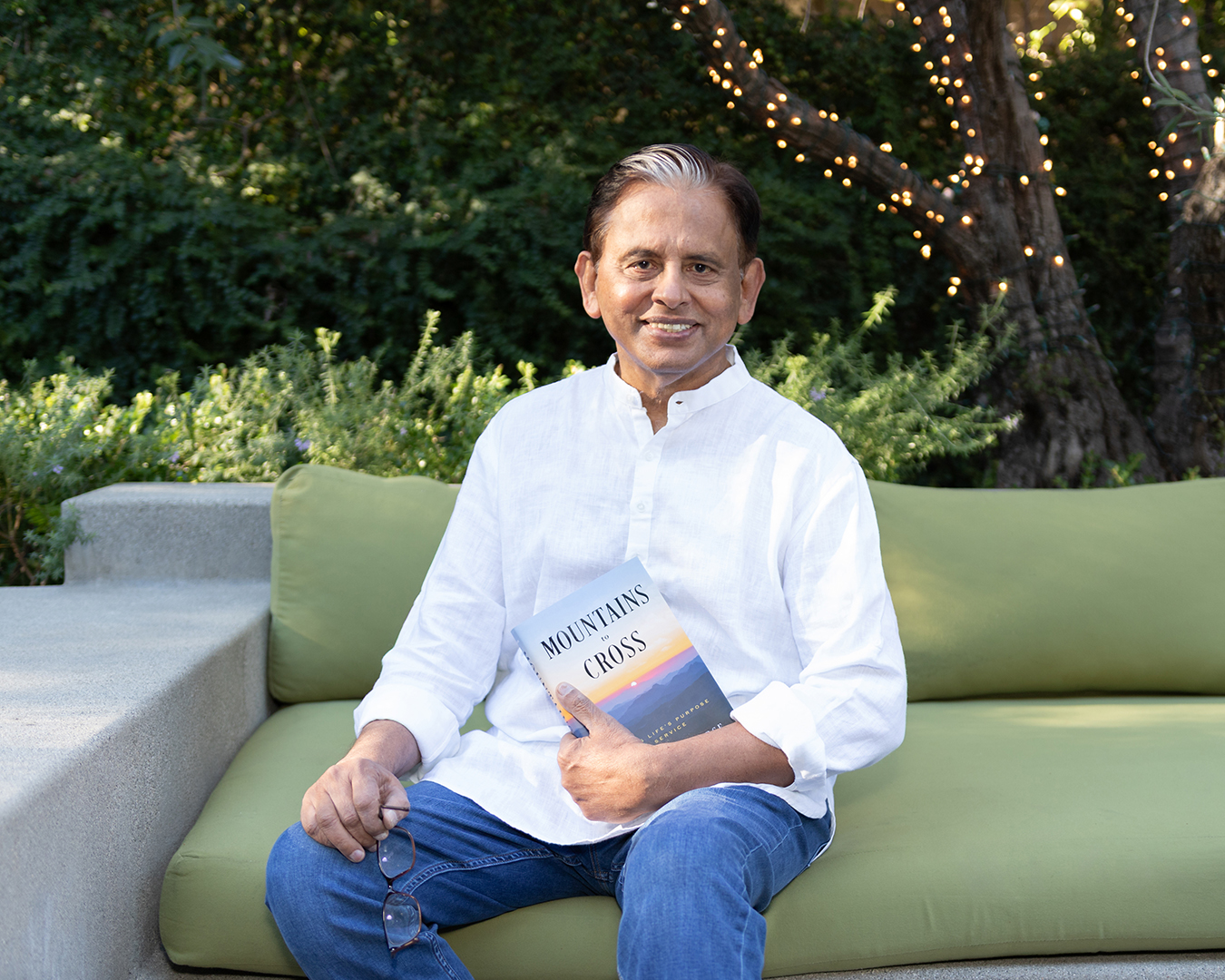
When the digital copy of Mountains to Cross landed in my email to review, it was the first time I was hearing of its author, Abraham M. George. In the subsequent week, I would find myself immersed in a story that was engaging and exciting, aspirational yet grounded. The story of a boy from a middle-class Indian family of educators who, starting as an officer in the Indian army, would move on to a resounding career success in the US in the 1980s and 90s and then return to his spiritual but impoverished land of India to set up a school for society’s lowest socio-economic classes.
The story of Shanti Bhavan entered my consciousness as a place where those bereft of hope were given the gift of hope through education and where many then went on to lift their families out of the dire abyss of poverty and degradation.
Brush with death
As a young officer in the Indian army, Abraham came close to being killed in a dynamite explosion when he was 18. Though hurt, he survived, but it led him to question the meaning of his existence. This was the primal and formative episode that was eventually to bring him back to India in the service of the poor.
At the time, in the 1990s, he was the founder of a multimillion-dollar company in the US and lived on a 23-acre, 7,000-square-foot property in New Jersey, replete with a swimming pool, volleyball and tennis courts, landscaped gardens, and a sizable saltwater aquarium. He was happily married, with two sons, Ajit and Vivek, who were growing up and needed their father’s presence, as all children do.
Leaving behind a life of luxury
Yet, Abraham chose to leave his family and children behind and come to India to redress disparities caused by the caste system and abysmal poverty in the villages around Bangalore. In the book, he explains with honesty that he was fulfilling an inner calling, a promise that he felt he had to keep.
A glimpse into his family background helps explain the path he eventually chose. Born to a Syrian Christian family in Trivandrum, Abraham’s father was a Kerala High Court judge who later became the dean of the government law college in the state. His mother was the second woman in India to obtain a doctorate in physics at a time when few women pursued higher education. She earned her doctorate from a European university, as Kerala didn’t offer doctorates at that time. She later studied and worked in the US, becoming the first in the family to do so and paving the way for their family’s emigration there in the late 1960s.
Formative experiences
Abraham grew up as one of four siblings, cossetted by his parents’ love and concern. Though not subject to caste prejudices himself, the unfair treatment meted out to lower castes left a deep impression on his young mind, especially during visits to his farmer-grandfather’s place in Ayyampilly, near Kochi, during family vacations.
Abraham also witnessed the subservience of Indian women in the joint family system through the example of the George family paterfamilias at Ayyampilly. These practices were to contrast strongly with the women’s liberation he came across in America in the 1970s, an experience that would shape his attitudes towards the education and upliftment of girls and women in the decades to come.
Another key childhood incident that influenced him profoundly was when his father soundly rebuked a man squabbling over religion and advised him to work among the poor instead of stirring trouble in the name of religion. This incident gave him insight into what his father truly valued. It was, in the depths of Abraham’s life, help that set the course for his future mission among the poor and downtrodden.
Attracted to the military from the age of 10, Abraham passed the National Defense Academy exam and, by 18, had joined the Artillery Corps in the army as a second lieutenant. He was subsequently posted to Se La (or Sela Pass), at about 14,000 feet in the eastern ranges of the Himalayas, to fend off the Chinese army. It was a risky, critical assignment. It was here that he almost died.
Around this time, he was gradually drawn to the writings of philosopher Bertrand Russell, who felt there was no justification for war. He was simultaneously inspired by the life of Dr. Albert Schweitzer, the German humanitarian and physician who traveled to Gabon, Africa, to offer medical aid to the natives of that region. Reflecting on that period, he says, “The youthful fantasy and glamour of the military had driven me to be a soldier, but having embraced Mahatma Gandhi’s principle of ‘ahimsa’—do no harm—I was no longer prepared to take life.” Some three years after joining the army, Abraham was honorably discharged due to a hereditary medical condition, tinnitus.

American success story
In December 1968, at the age of 22, he followed his mother to the US, where she was at a teaching post in Alabama. Gradually, the rest of the family joined them. In due course, this bright lad earned an MBA from the University of Alabama, followed by a Ph.D. from the New York University’s Stern School of Business. He later picked up a well-paying job at Chemical Bank in New York (which later merged with Chase). Around the same time, a semi-arranged marriage to Mariam followed. The couple then started settling down in America.
His American story is well chronicled. After resigning from his bank job, Abraham started his own company to help multinational corporations manage international currency risk. By the early 1990s, his company, MCM, had become a market leader in its field, and Abraham established an international office in London to serve the European market.
A huge upgrade happened when Credit Suisse First Boston partnered with his company for consulting services to international banks. Over the next five years, Abraham entered the world of luxury and privilege as the new company went on to advise nearly 50 Fortune 500 companies across several cities in the US.
Shanti Bhavan takes shape
Yet, in 1995, driven by his mission to serve the poor, Abraham returned to India and started working on his school project from Bangalore. The school aimed to admit children of the lowest socioeconomic strata of Indian society—those from the caste-oppressed communities, as well as the Dalits and outcasts.
Abraham chose not to involve the Indian government, as he wanted autonomy for his institution, even though the government was involved in most social upliftment ventures at the time. Through education, the founder of Shanti Bhavan aimed to bridge the economic disparities of its students from impoverished backgrounds and make them top earners within one generation.
Thirty years on, Abraham, Mariam, and their son Ajit currently live at Shanti Bhavan, in Baliganapalli village in Tamil Nadu, managing the residential school for disadvantaged children. Since it opened in 1997, thousands of village children have passed through its doors. Shanti Bhavan makes it its mission to look out for the poor kids for nearly 18 years of their life—from the lowest grades through college and beyond their first job. Some of the village children have gone on to study at international centers of excellence such as Duke University, MIT, Dartmouth, Princeton, and Stanford. Many school and college graduates have worked with companies like Goldman Sachs, Ernst & Young, Apple, Keystone, Atlassian, and William Blair.
While Abraham George has many more accomplishments to his name – such as the founding of the Indian Institute of Journalism and New Media (IIJNM), Bangalore; being a catalyst for the introduction of lead-free gasoline in India from 2000 onwards; creating the Baldev Medical and Community Centre that serves 17 villages and 16,000 people near Shanti Bhavan; as well as rural upliftment schemes for women—perhaps his most significant contribution, in the long run, will be Shanti Bhavan.
By helping individuals escape cycles of generational poverty and uplifting entire families in the process, he has rendered service of remarkable scope and scale to Indian society.

- Mountains to Cross: Finding Life’s Purpose in Service by Dr. Abraham M. George, 336 pages, published by Greenleaf Book Group.
- Ebook: $9.99; Hardcover: approx. $29

Praise for the book
N.R. Narayana Murthy – Philanthropist; Founder & Chairman Emeritus of Infosys, has praised Abraham’s extraordinary life journey and enduring contribution to social upliftment, saying, “Dr. Abraham George’s story demonstrates how one person’s vision and perseverance can transform an entire community, turning generational poverty into hope and opportunity. His life’s work is a shining example of aligning business acumen with a profound dedication to social justice, yielding inspiration for leaders and citizens alike.”


Leave a Reply